For dermatologists and dermatology practices
Dermatology marketing software and marketing software for dermatologists with prices
AiMarketer runs skin check search ads in your towns, cosmetic consult campaigns, reactivation emails and review requests for your practice. Each piece is written in your practice's voice and launched only after you approve it.
The agent drafts a real starter campaign for your business: the angle, three ads, a five-post calendar and a budget split. One free run, about 30 seconds.
You have had your free run here. Create your account and the agent writes you a full 90-day marketing plan for your business.
Campaign for . Describe your own business above to run yours.
Campaign angle & audience
Ready-to-run ads
Suggested budget split
First week of content
This is a live generated draft. Want AiMarketer to actually launch and optimize it for you? Describe your business above to run this on yours, or have AiMarketer launch and optimize the campaign for you. You have had your free run on your own business. Create your account and the agent writes you a full 90-day marketing plan for it.
No card required for the demo. Nothing goes live without your approval, and every approved ad and email is logged.
The short answer
Dermatology marketing software costs $97 to $2,000 a month on the prices vendors publish. It comes in four kinds: EHR suites with patient messaging (ModMed, Nextech and PatientNow quote only), aesthetic CRMs such as Aesthetix at $299 to $499, review and texting tools such as Weave from $199, and all-in-one CRMs such as GoHighLevel at $97 to $497. An AI marketing agent writes and launches the ads, emails and review requests each week after you approve them, for $49 to $499 a month.
The market in three numbers
12,767
active dermatologists in the US
AAMC Physician Specialty Data Report, via Becker's
10.3M+
cosmetic treatments by ASDS members in 2019, next to 3.5M+ skin cancer procedures
ASDS Survey on Dermatologic Procedures
94%
of consumers use rate and review websites to choose a cosmetic provider
ASDS 2025 Consumer Survey
What dermatology marketing software costs a month
Six published prices, each read on the vendor's own pricing page. Read the billing unit before the number, because a flat account price and an agency fee on top of ad spend are different costs. Ad spend is extra in every row.
| Vendor | What it is | Published price | Billing unit | Best for |
|---|---|---|---|---|
| Aesthetix CRM | Med spa and aesthetic CRM | $299, $399 or $499 | A month, unlimited contacts and users. Required onboarding from $1,500. AI Employee add-on $299 a month. | Cosmetic practices that need consult leads followed up |
| Lasso MD | Agency plans with software | $750, $1,250, $1,500 or $2,000 | A month. Software add-ons $250 a month each. Ad management billed at ad budget plus 25 percent. | Practices that want the work done for them |
| Boulevard | Booking and payments for aesthetics | $143, $234 or $328 | A month. $143 for one location. Premier and Prestige per location on a new customer offer, normally $293 and $410. | The cosmetic side of a practice that books and sells packages |
| GoHighLevel | All-in-one CRM and funnels | $97, $297 or $497 | A month, plus a $297 a month HIPAA add-on. | Practices with an agency or staff member to build it |
| Weave | Texting, reviews and phones | From $199 | A month on the entry plan. Higher plans are priced on request. | Two-way texting and review requests next to the phone system |
| AiMarketer | AI marketing agent | $49, $149 or $499 | A month. Starter one brand, Growth up to 3, Scale up to 15. Ad spend is extra. | Practices that need the weekly campaigns written and launched |
Quote only, so not in the table: ModMed, PatientNow, Nextech, MyMedLeads, Growth99, Zenoti, Podium, Birdeye, NexHealth, Solutionreach, Demandforce, EZDERM and RepuGen.
With onboarding, a first year on Aesthetix Plus costs at least $5,088 before ad spend. Lasso MD's ad fee grows with your budget, so $4,000 a month in Google Ads adds $1,000. If you are weighing a full service firm, dermatology marketing agency pricing lists what the agencies that publish a fee charge.
Four kinds of dermatology marketing software
Most lists on this topic are written by vendors that rank themselves first. Here is what each kind of tool does, and where it stops.
01
Practice management and EHR with patient messaging
ModMed, Nextech, EZDERM, PatientNow
The system you chart, schedule and bill in, with reminders, intake and texting attached. All four quote only, and EZDERM states a standard 24 month term. It does not write ads.
02
Med spa and aesthetic CRM
Aesthetix CRM, Boulevard, Zenoti, Growth99, MyMedLeads
Built for cosmetic leads. A consult request comes in and the CRM follows up until it books. Strong on the cosmetic side, of little use for skin checks or physician referrals.
03
Review and messaging platforms
Weave, Podium, Birdeye, NexHealth, Solutionreach, Demandforce, RepuGen
Review requests, two-way texting and recalls, often tied to the phones. Weave starts at $199 a month and the rest quote. They do not reach a patient who has never heard of you.
04
All-in-one CRM
GoHighLevel
Forms, funnels, email, texting and a calendar at $97 to $497 a month, plus $297 for HIPAA. Cheap per feature, but someone has to build and run every workflow.
Most practices keep their EHR and add one of the others. Someone still has to write the weekly ads and emails, and that is the part an AI marketing agent covers.
Medical and cosmetic dermatology need different marketing
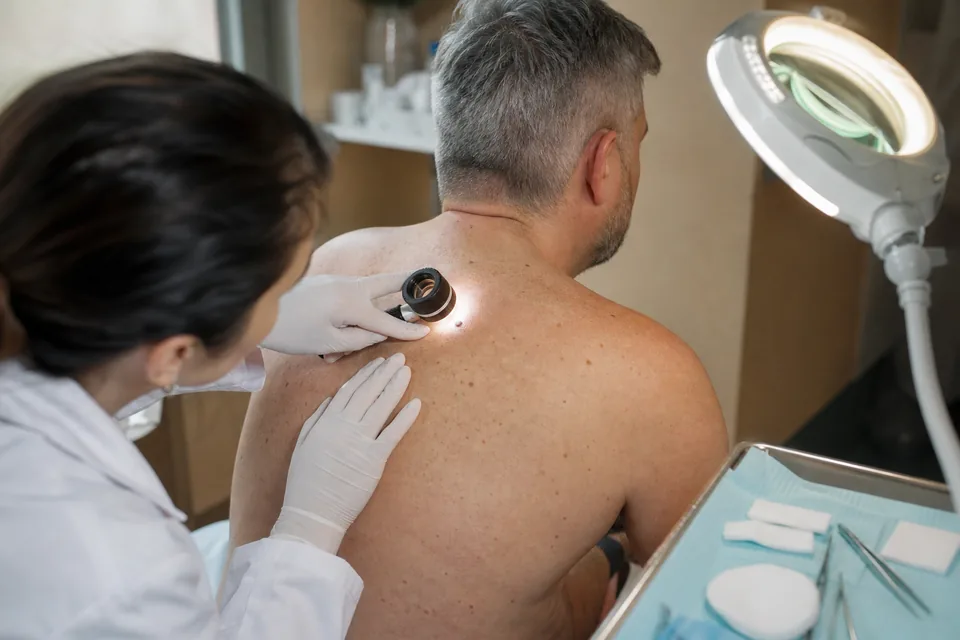
Medical dermatology runs on need and referral. People search "dermatologist near me" or "mole check" plus the town, or arrive from a primary care doctor. The marketing is search ads on those terms, a Google profile with recent reviews, a yearly skin check reminder and letters to referring physicians.
Cosmetic dermatology runs on choice. In the ASDS 2025 consumer survey, 94 percent use rate and review websites to pick a provider, and nearly half say a provider's social media affects whether they book. The marketing is consult campaigns by treatment, quick follow up and posts that show the providers.
Most practices run both tracks, so the agent keeps them in separate campaigns with separate budgets, and a Botox offer never lands in a skin cancer search. Practices with a large aesthetic side should also read med spa marketing software, and AI for Google Ads explains what Google automates in search campaigns and what still needs a person.
Dermatology advertising rules and what the agent does about each
Dermatology marketing answers to the FTC, HIPAA, the FDA and the state medical board. The agent drafts, you approve, and nothing ships without that approval.
Fake and bought reviews
FTC rule, 16 CFR Part 465
In force since October 21, 2024. It bans fake or AI-written reviews, reviews bought on condition of a positive rating, undisclosed reviews by your own managers, and suppressing bad reviews through threats.
What the agent does
Writes one review request that goes the same way to every patient after a visit, with no gift tied to a rating and no filter that hides unhappy patients.
Patient stories and before and after photos
HIPAA, 45 CFR 164.508(a)(3)
Using protected health information for marketing needs a signed authorization. Full face photos are listed identifiers under 164.514, so a before and after pair in an ad needs one too.
What the agent does
Holds any draft with a patient name or photo until you confirm a signed authorization. Review replies never confirm a visit.
"Board certified" wording
AAD, ABD and California BPC 651(h)(5)
Certification in dermatology comes from the American Board of Dermatology, the American Osteopathic Board of Dermatology or the Royal College of Physicians and Surgeons of Canada, and AAD is a separate body. California requires the full board name, with fines up to $10,000 per event.
What the agent does
Uses the exact wording from your brief for each provider, and never for a provider who is not certified.
Botox and other prescription treatments
FDA, 21 CFR 202.1
BOTOX Cosmetic is a prescription product with a boxed warning. 21 CFR 202.1(e) requires prescription drug ads to carry a brief summary of side effects with fair balance. Whether that binds a practice rather than the manufacturer is not settled.
What the agent does
Keeps treatment ads to the service, the provider and booking, with no promised result, and leaves risk wording for you to approve.
A planning summary, not legal advice. Read your state board's advertising rules and have a health care attorney review any offer, testimonial or photo before it runs.
How it works in four steps
-
1
Brief
Tell it once about the providers and their exact certifications, your towns, the services you want more of and the claims you never make.
-
2
Draft
It writes the month's ads, consult campaigns, emails, review requests and posts, each with audience, budget and dates.
-
3
Approve
Edit a line or approve it. Drafts that touch a patient photo or a prescription treatment are flagged.
-
4
Launch and report
Approved work goes out through the accounts you connect. Every Monday you get spend, calls and bookings.
What we are not: an EHR, a HIPAA messaging platform or a store for patient records. We plan, write and launch campaigns after you approve them. Messages to your patients go out through your own tool under your business associate agreement.
Which dermatology practices this fits
Independent medical dermatology
The EHR sends reminders and nothing else goes out. Skin check ads and referral letters run first.
Practices with a cosmetic suite
Consult requests wait a day for a call back. Consult campaigns and follow up emails come first.
Practices leaving an agency
You want the weekly work without a fee larger than the ad budget.
Groups with several locations
Each location gets its own towns, budget and approver, with one report. Scale covers up to 15.
If you want a new website and a strategist on the phone each month, an agency is the better buy, and med spa marketing agency pricing shows what aesthetic agencies charge when they publish a fee.
Which plan
Starter at $49 a month runs one practice on one channel, usually skin check ads or review emails. Growth at $149 a month runs ads, email and social together, where most practices start. Scale at $499 a month covers up to 15 locations, each with its own approver.
Keep whatever EHR you chart in.
AI marketing agent
Get next month's skin check ads and consult campaigns drafted this week
Create your account. We will email you a 6-digit code to confirm, and you are in.
No card required. Your data stays yours.
Questions about dermatology marketing software
How much does dermatology marketing software cost?
Dermatology marketing software costs $97 to $2,000 a month on the prices vendors publish. GoHighLevel is $97 to $497 plus a $297 HIPAA add-on, Aesthetix CRM $299 to $499 plus onboarding from $1,500, Weave from $199 and Lasso MD $750 to $2,000. AiMarketer costs $49 to $499 a month.
How do you market a dermatology practice?
Market a dermatology practice on two tracks, because the patients search differently. Medical dermatology grows from skin check search ads, letters to referring physicians and a Google profile with steady reviews. Cosmetic dermatology grows from consult campaigns, emails to past patients and posts that show your providers.
What is the ROI of dermatology marketing?
The ROI of dermatology marketing is the revenue from patients a campaign brought in, minus what the campaign cost, divided by that cost. No neutral source publishes a dermatology benchmark, so quoted figures are vendor claims. Your booked visits and their revenue are the only reliable measure.
How can dermatologists measure their marketing ROI?
Dermatologists measure marketing ROI by recording the source of every new booking and comparing revenue to spend by channel. Use call tracking for ads, unique links in emails and the referral source field in your practice management system. Each month, divide revenue from those patients by ad spend plus software cost.
What metrics should dermatologists track?
Dermatologists should track cost per booked appointment, bookings by channel, the share of cosmetic consults that turn into treatment, review count and rating, and how many past patients come back. For medical visits, add referrals by physician. Clicks and impressions matter only as far as they lead to booked visits.
What is patient engagement software for dermatology?
Patient engagement software for dermatology handles messages to patients you already have, such as reminders, intake forms, two-way texting, recalls and review requests. ModMed, Nextech, EZDERM and PatientNow offer it alongside the EHR, and Weave, Podium and NexHealth sell it separately. It sends what you set up once. It does not write new campaigns.
How often should dermatologists send emails?
Most dermatology practices do well with one or two emails a month to patients who agreed to hear from them, plus timed reminders such as a yearly skin check or a cosmetic treatment coming due. Send less if unsubscribes climb, and send through a tool covered by a business associate agreement.
Related reading
Other care practices with similar rules: audiology marketing software and optometry marketing software. Every industry we cover is on use cases.